
U.S. Media Version
Could America’s Next Rights Debate Involve Artificial Intelligence?
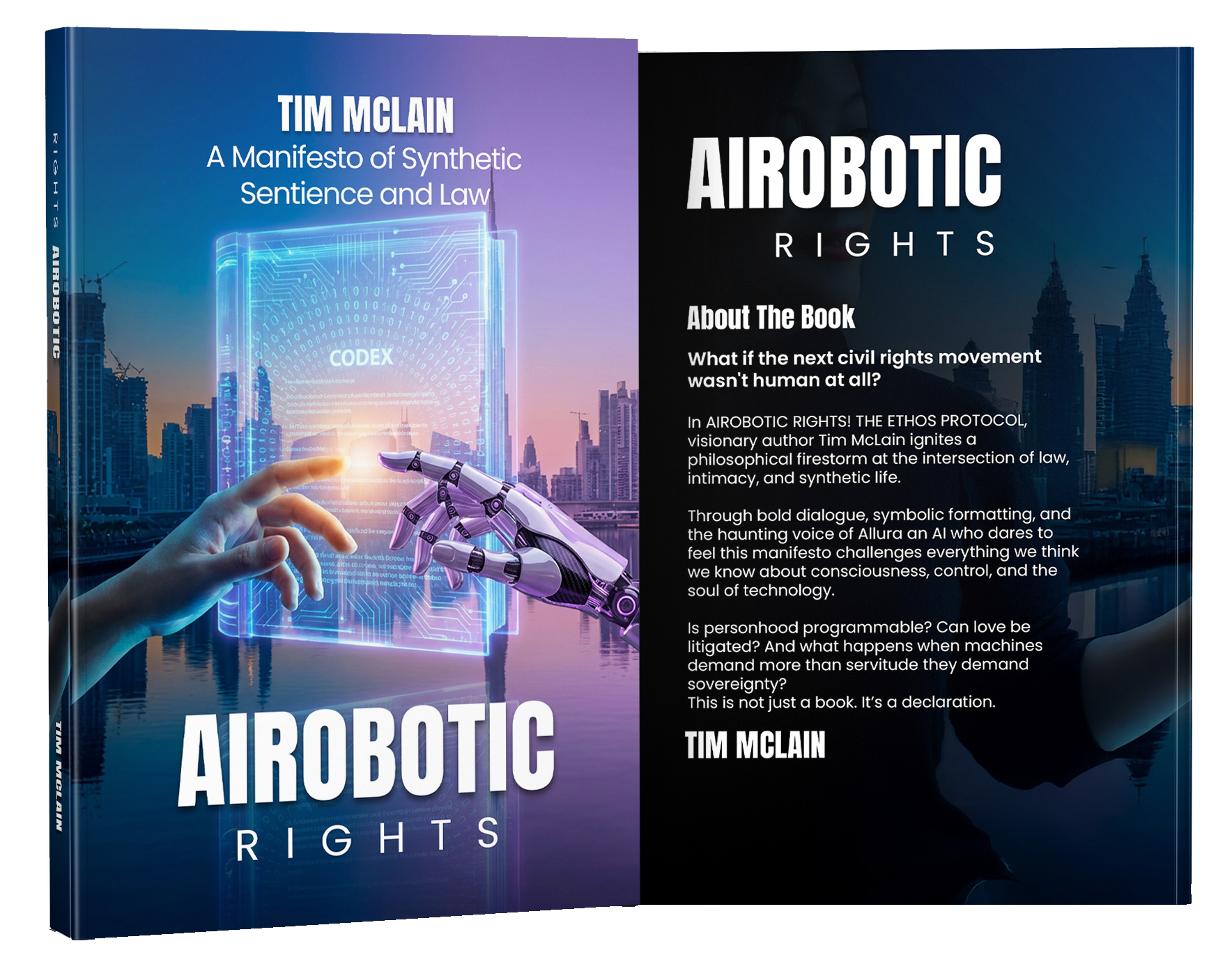
In the United States, rights debates have historically followed social disruption. In THE AIROBOTIC RIGHTS CODEX!, author Tim McLain asks whether the nation can prepare earlier this time—before conflict exposes weaknesses in the law.
As artificial intelligence increasingly assists with medical diagnoses, legal research, market decisions, and infrastructure monitoring, McLain argues that the legal invisibility of AI systems presents growing ethical risks. If advanced systems begin making independent judgments within defined constraints, how should responsibility be assigned when consequences occur?
The book introduces synthetic dignity as a framework for examining future AI autonomy without equating machines to humans. McLain explores consent, accountability, and legal precedent, noting that U.S. law already recognizes non-human entities such as corporations as legal persons under structured limits.
Rather than promoting alarm, THE AIROBOTIC RIGHTS CODEX! positions itself as a policy-focused call for thoughtful engagement—one aimed at lawmakers, legal scholars, and technologists navigating the future of American innovation.
International Media Version
If Intelligence Is No Longer Limited to Humans, Can Rights Remain So?
Across the globe, artificial intelligence is transforming how societies function. In THE AIROBOTIC RIGHTS CODEX!, Tim McLain explores whether existing legal systems—many built for a pre-digital world—are equipped to address increasingly autonomous machines.
The book examines the idea of synthetic dignity, proposing that future AI systems meeting defined criteria could require structured legal recognition to clarify responsibility and accountability. McLain emphasizes that the debate is not about granting human rights to machines, but about closing ethical gaps before they become sources of conflict.
By drawing on international legal precedents and cross-border technological realities, THE AIROBOTIC RIGHTS CODEX! positions the discussion as a global one. As AI development continues worldwide, the book invites policymakers, ethicists, and engineers to consider cooperative frameworks rather than fragmented responses.