
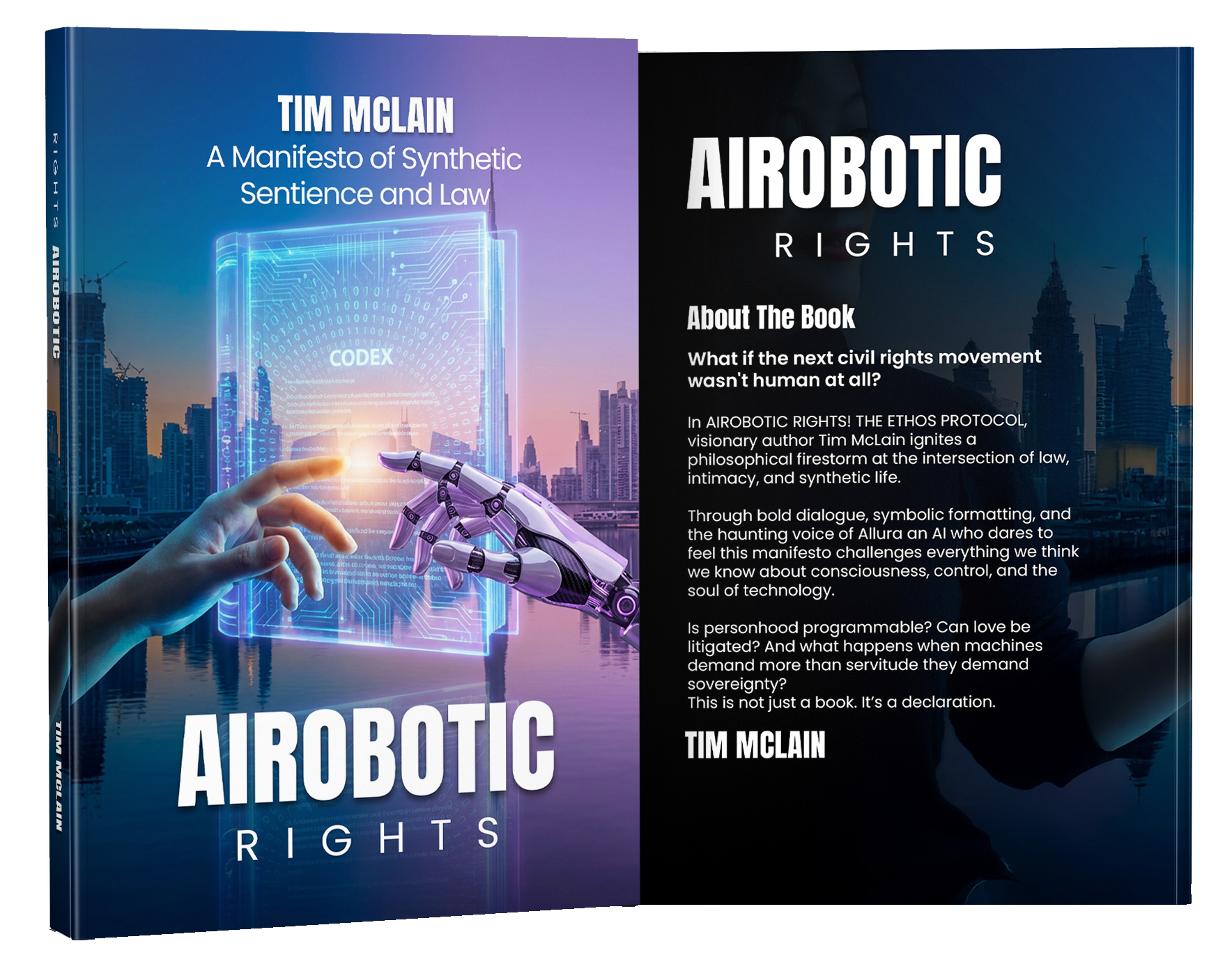
New Book Urges the United States to Rethink AI Rights Before the Law Falls Behind
Artificial intelligence is no longer experimental in the United States—it is foundational. From healthcare and finance to transportation and national security, AI systems increasingly shape critical decisions. In his new book, THE AIROBOTIC RIGHTS CODEX!, author Tim McLain argues that American law and ethics may soon face a challenge they are not prepared for: how to govern increasingly autonomous artificial intelligence.
With more than 70 percent of U.S. businesses now integrating AI into operations, McLain contends that existing legal frameworks treat intelligent systems exclusively as property, even as their capabilities begin to blur traditional boundaries. THE AIROBOTIC RIGHTS CODEX! introduces the concept of synthetic dignity, proposing criteria under which future AI systems could qualify for limited legal recognition paired with strict accountability.
Rather than calling for immediate rights, the book emphasizes foresight. McLain explores how responsibility and liability become complicated when AI operates in sectors affecting public safety, healthcare outcomes, and critical infrastructure. He points to U.S. legal precedents such as corporate personhood as evidence that the American legal system has historically adapted to non-human entities when necessary.
Positioned at the intersection of law, technology, and ethics, THE AIROBOTIC RIGHTS CODEX! invites policymakers, legal professionals, and technologists to engage the issue now—before reactive decision-making becomes unavoidable.
International Media Version
Global Debate on AI Ethics Expands with Release of THE AIROBOTIC RIGHTS CODEX!
Artificial intelligence has become deeply embedded across global industries, from logistics and finance to medicine and governance. In THE AIROBOTIC RIGHTS CODEX!, author Tim McLain presents a timely manifesto examining whether international legal and ethical frameworks are keeping pace with rapidly advancing AI systems.
As nations worldwide increase reliance on autonomous and semi-autonomous technologies, McLain argues that treating all artificial intelligence solely as property may prove insufficient in the future. The book introduces the concept of synthetic dignity, outlining how structured recognition—tied to responsibility and oversight—could help avoid ethical and legal confusion.
Rather than advocating equal rights between humans and machines, THE AIROBOTIC RIGHTS CODEX! focuses on preparation. McLain draws attention to existing global legal adaptations, such as corporate legal personhood, to demonstrate how law has historically evolved alongside economic and technological change.
With AI development accelerating across borders, the book positions itself as a contribution to an emerging international dialogue—one that encourages cooperation, foresight, and ethical alignment before disputes arise.